Fast, tiny, and friendly code generator that turns your C structs into fully featured JSON serializers/deserializers.
Highlights
- Schema-first workflow – describe your structs once, generate battle-tested C code automatically.
- Zero runtime reflection – everything happens at compile time, so the generated code stays fast and lean.
- Thread-safe runtime – the parsing context uses explicit structures rather than globals.
- Batteries included – includes a lightweight
sstrstring helper library and ready-made array helpers. - CI-friendly build – warnings are treated as errors and the Make targets work the same locally and in automation.
Benchmark

json-gen-c is faster than cJSON on all benchmarks — up to 47% faster marshal, 25% faster unmarshal — while providing type-safe code generation, selective parsing, and multi-format support (JSON + MessagePack + CBOR). See benchmark/RESULTS.md for full results and reproduction steps.
Contents
- Benchmark
- Overview
- Build and Install
- Quick Start
- The Format of Structs Definition File
- The JSON API
- More Resources
- Contributing & Community
Overview
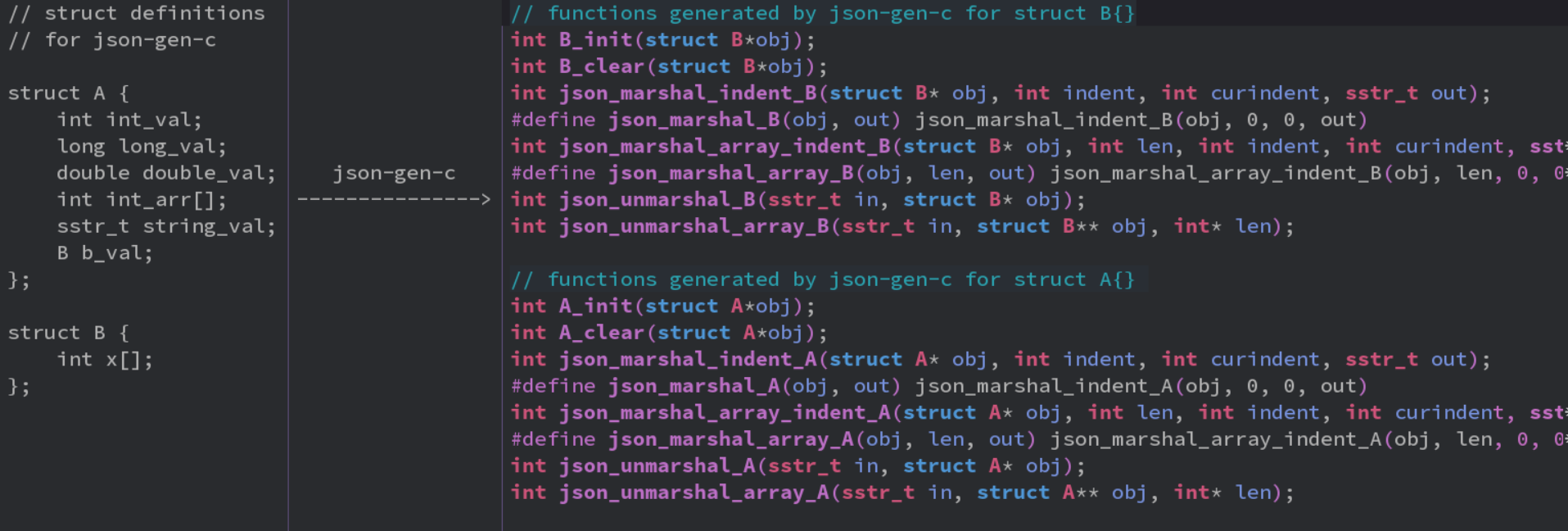
json-gen-c is a program for serializing C structs to JSON and deserializing JSON to C structs. It parses struct definition files then generates C code to handle both directions.
Build and Install
The project uses a modern, efficient build system with support for parallel compilation:
To build example, tests, and benchmarks
make benchmark-repro installs the distro benchmark dependencies when needed, clones yyjson into benchmark/yyjson/, installs it locally under benchmark/.deps/prefix/, then builds and runs the full benchmark suite with -O2 -DNDEBUG. Both local dependency directories are gitignored on purpose.
All build artifacts are organized under the build/ directory:
build/bin/- Main executablebuild/lib/- Static libraries
build/example/- Example executablebuild/test/- Test executablesbuild/benchmark/- Benchmark executable
Alternative Build Systems
CMake (3.16+):
Windows (CMake + MSVC):
Windows (CMake + MinGW):
Note: On Windows, CMake automatically uses a built-in
xxdreplacement (cmake/xxd.cmake). No external tools beyond a C compiler and CMake are needed.
Meson:
See BUILD_SYSTEM.md for pkg-config integration, find_package(JsonGenC), and the json_gen_c_generate() CMake macro.
Package Managers
Homebrew (macOS/Linux):
To set up the tap, see packaging/homebrew/.
Debian/Ubuntu (from source package):
Arch Linux (AUR):
Quick Start
Define Structs
For example, create a file name struct.json-gen-c as contents below:
Note that we don't use C-style string char*, a more resonable type is sstr_t. You can find more details about sstr_t in document of sstr.
Compiling Your Struct Definition File
This generates the following files in your specified destination directory:
json.gen.h, the header which declares your generated structures and functions.json.gen.c, which contains the implementation of your functions.sstr.h,sstr.c, the string manipulation helper functions that generated code depends on.
MessagePack Format
To generate MessagePack (binary) serialization instead of JSON:
This generates msgpack.gen.h and msgpack.gen.c with msgpack_pack_* / msgpack_unpack_* functions. The struct definitions and sstr helper are identical regardless of format.
CBOR Format
To generate CBOR (RFC 8949) binary serialization:
This generates cbor.gen.h and cbor.gen.c with cbor_pack_* / cbor_unpack_* functions. Same struct definitions and API patterns as JSON and MessagePack.
C++ Wrapper (Optional)
This generates json_gen_c.gen.hpp — a C++17 header with RAII wrapper classes inside namespace jgc. Each class wraps a generated C struct with:
- Default constructor (
_init), destructor (_clear), move and copy semantics backed by the generated C copy/move helpers for JSON output - Typed get/set accessors (strings as
std::string, enums as their C enum type) marshal(),unmarshal(), andunmarshal_into()member functions- Equality operators and
c_struct()for C interop
Can be combined with --format to also generate MessagePack or CBOR alongside.
Rust Module (Optional)
This generates json_gen_c.gen.rs — a self-contained Rust module with native serde-compatible structs and enums. Add serde and serde_json to your Cargo.toml, then:
Type mapping: int→i32, long→i64, float→f32, double→f64, sstr_t→String, enums→Rust enums, oneof→#[serde(tag)] enums, optional→Option<T>, arrays→Vec<T>/[T; N], maps→HashMap<String, V>.
Go Source (Optional)
This generates json_gen_c.gen.go — a self-contained Go source file using encoding/json struct tags. No external dependencies required:
Type mapping: int→int32, long→int64, float→float32, double→float64, sstr_t→string, enums→type E string, oneof→custom marshal/unmarshal, optional→*T + omitempty, arrays→[]T/[N]T, maps→map[string]V.
Use Your Generated Codes
To Serialize Structs to JSON
To Serialize Array of Structs to JSON
To Deserialize JSON to Structs
To Deserialize JSON to Array of Structs
To Copy or Move Generated Objects
Every generated struct and oneof type also has deep-copy and ownership-transfer helpers:
<type>_copy(dest, src) clears dest before performing a full deep copy. Strings, arrays, maps, nested structs, oneof payloads, and optional/nullable presence flags are duplicated so the result does not share owned storage with src. If allocation fails, it returns -1 and leaves dest in a clearable state; the previous dest value is not preserved.
<type>_move(dest, src) clears dest, transfers ownership from src, then leaves src in a clearable moved-from state without reapplying schema defaults. Self-copy and self-move return 0 without changing the object.
To Selectively Deserialize Top-Level Fields
Selective unmarshal only updates the chosen top-level fields that are present in the JSON input. Unselected top-level fields stay unchanged.
Selected fields are treated as whole-field replacements: if a selected field is a string, array, map, nested struct, or oneof, its previous stored value is cleared before the new JSON value is parsed.
To Selectively Deserialize Nested Sub-Fields
Use the _deep variant to pass sub-field masks into nested structs:
When nested_masks is NULL or no entry matches a field, the nested struct is parsed in full (same as the non-deep API). Sub-masks can be chained recursively via the sub_masks / sub_mask_count members for deeper nesting levels.
Field-mask constants use the generated C field names, even when @json aliases change the JSON key names.
Build System
For detailed build system documentation, see BUILD_SYSTEM.md. If you are new to the project, the friendly walkthrough in docs/GETTING_STARTED.md covers installation, schema authoring, and integration.
The Format of Structs Definition File
Define a struct like:
The field type can be one of the following:
intlongfloatdoublesstr_tbool- an enum name
- a struct name
- a oneof name (tagged union)
map<sstr_t, V>where V is any of the above types
If a field is a dynamic array, just append [] after the field name. For fixed-size arrays, use [N] where N is a positive integer (e.g., int data[10];).
Map fields
Map fields marshal to/from JSON objects. The key type is always sstr_t (JSON keys are strings). Example:
In generated C code, each map is represented as a dynamic array of key-value entries:
Tagged unions (oneof)
Tagged unions (discriminated unions) represent a value that can be one of several types, identified by a discriminator tag field in JSON:
@tag "field"sets the JSON discriminator key (defaults to"type"if omitted).- Each variant references a previously defined struct.
- JSON uses a flattened representation:
{"type":"circle","radius":5.0}.
<tt>@deprecated</tt> Annotation
Mark fields, enum values, or oneof variants as deprecated:
Deprecated items remain fully functional in marshal/unmarshal. The generated C code annotates them with compiler deprecation attributes so downstream code that accesses them gets a warning. See doc/schema-evolution.md for migration patterns and compatibility rules.
Oneof types can be used as fields in structs:
The JSON API
Use the generated helper macros to manage mask bits:
For json_unmarshal_selected_<struct_name>() and _deep():
- passing
NULLor too few mask words returns an error - unselected top-level fields are left unchanged
- selected fields that appear in the JSON input replace the old stored field value
- field indices use C member names, not aliased JSON key names
_deepadditionally acceptsjson_nested_maskentries for sub-field selection within nested structs
Editor Support
VS Code Extension
The editors/vscode/ directory contains a VS Code extension providing:
- Syntax highlighting — TextMate grammar for
.json-gen-cfiles (keywords, types, annotations, etc.) - Language Server — Real-time diagnostics, code completion, and hover information
To enable the language server, ensure json-gen-c is on your PATH (or set jsonGenC.serverPath in VS Code settings), then install the extension. It launches json-gen-c --lsp automatically.
LSP for Other Editors
Any LSP-capable editor can use the built-in language server:
This runs an LSP server over stdin/stdout (JSON-RPC 2.0). Configure your editor to launch it as a language server for .json-gen-c files.
More Resources
- docs/GETTING_STARTED.md – step-by-step tutorial with code snippets.
- example/ – real schemas plus sample host programs.
- Online reference – API documentation generated via Doxygen.
- doc/json-gen-c.1 – manual page installed with the CLI.
- doc/schema-evolution.md – schema evolution guide (compatibility rules, migration patterns,
@deprecated).
Contributing & Community
We welcome issues, ideas, documentation updates, and code contributions.
- Read the CONTRIBUTING.md guide for local setup, coding style, and pull-request tips.
- File bugs or feature requests via GitHub Issues with clear reproduction details.
- Share what you build! Open a discussion or PR if you want your project added to a future showcase section.
Thanks for helping json-gen-c grow. Happy hacking!
License
Codes of json-gen-c are licensed under GPL-3.0, except for the codes it generated. The copy right of the codes generated by json-gen-c is owned by the user who wrote the struct definition file, same as the copy right of a PDF file generated by Latex is owned by the user who wrote the tex file.